
Wrestling Heritage welcomes memories, further information and corrections
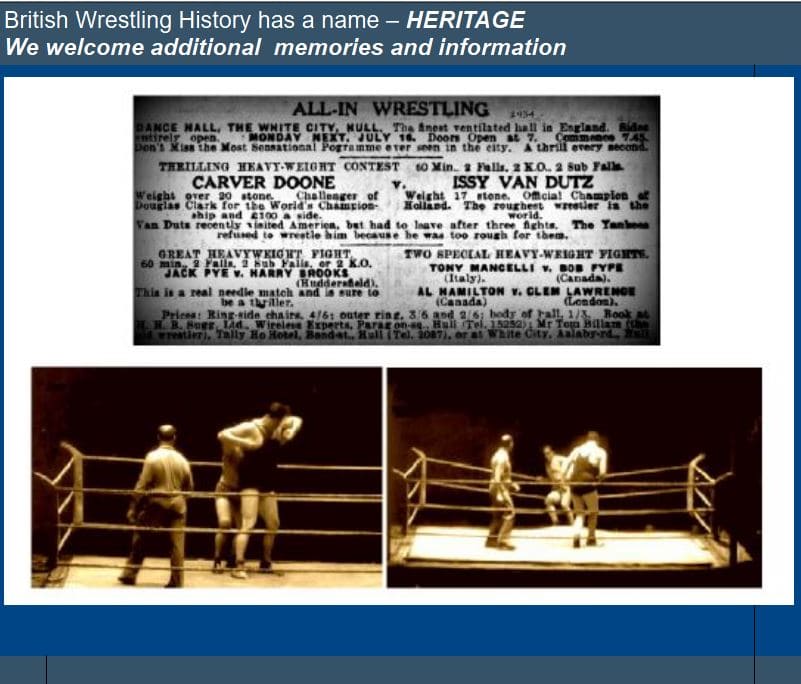
Whilst we have previously questioned some aspects of Atholl Oakeley’s interpretation of wrestling history we will willingly give him some credit. He was a creative and talented promoter and a major player in the resurgence of British wrestling in the 1930s. He was also the creator of some of wrestling’s greatest characters, one of whom was Carver Doone. Oakeley was obsessed with Lorna Doone, a novel by Richard Doddridge Blackmore. In “Blue Blood On the Mat” he writes that he took one look at Jack Baltus and immediately named him after Blackmore’s creation, Lorna Doone.
Carver Doone was the stuff of legends. Irrespective of any wrestling skill he may or may not have possessed few names are as evocative as the name given to Jack Baltus.
Although Oakeley portrays Carver Doone as some invincible monster, “The Frankenstein of Devon,” the results we have seen suggest something otherwise. Doone was said to stand seven feet tall, we’d settle on 6’9″ max. Doone was a headline act for Oakeley, said to weigh anything up to 29 stones. Certainly a tall, well built man, but no monster, he was well proportioned. It wasn’t just the height or the name that were fictitious. Carver Doone was not from Devon (he was from London), he hadn’t met all the best American wrestlers whilst living there for two years (he may have boxed in America), and we seriously doubt that he was a product of the public school system or had worked on the Stock Exchange.
Returning from Canada in February, 1932, Carver Doone was quickly seized upon by Oakeley and persuaded to ready himself for life as a professional wrestler. Oakeley did a good job at making the giant, already heavyweight champion of Devon and Cornwall (more fiction) look almost invincible.
Carver Doone’s over-reliance on his size and strength made him something of a novelty and led inevitably to a short career that fizzled out in 1938. Opponents were carefully chosen to allow him to create his monster of the mat persona. Men like Jack Pye, Izzy Van Dutz, Norman the Butcher, and Ben Sherman were regular opponents with the qualities of being famous names, less than fully blown heavyweights, and a generosity to make him look good. Occasionally other big men of limited ability such as Jumbo Giles and John Bell would be matched with him but put Carver Doone in with a wrestler of Douglas Clark’s calibre and the result was very different. Clark had the strength to lift and toss Doone at will, it taking just thirteen minutes for the champion of Devon and Cornwall to lay battered, bruised and stretched out on the mat face downwards.
Irrespective of wrestling ability, or lack of it, in the wonderful world of professional wrestling we feel he deserves acknowledgment as one of the top wrestlers of the 1930s.

Now read Ron Historyo’s
On the Trail of Carver Doone
941CD
 Wrestling Heritage