
Also known as Aussie Dean
Wrestling Heritage welcomes memories, further information and corrections.
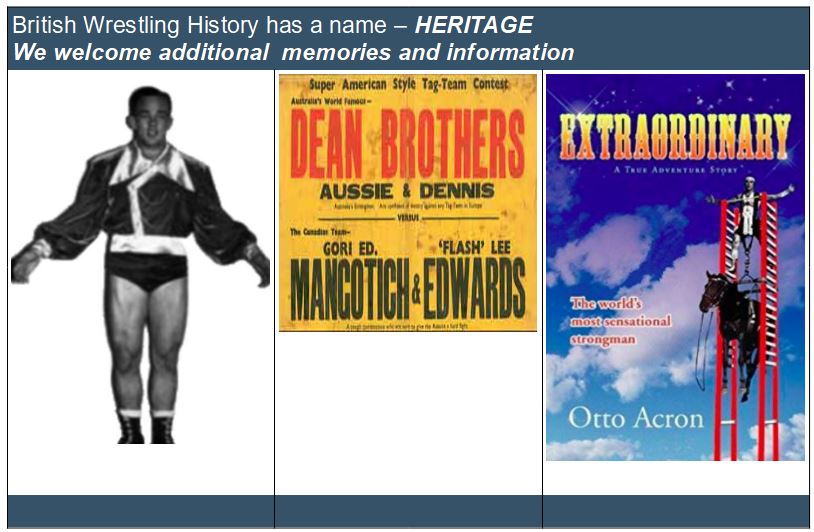
A Remarkable Man from The Land Down Under
Australian Otto Acron may only have wrestled in Britain for a few months in 1962, but don’t let this lack of British exposure prevent you from reading a remarkable story. Acron, real name Alexander Alsop, was born in Sydney in 1935. His father was a very strong man who worked on the railways.
As a child Alex read about the exploits of a South African strongman who could carry a horse up a ladder! He was mesmerised by the thought and inspired to emulate what must surely have been impossible fiction.
Thoughts of carrying a horse up a ladder were put to one side, albeit temporarily, after being taken to Sydney’s Leichardt Stadium to watch the wrestling. Twelve year old Alexander was now going to be a professional wrestler!
Yet it was boxing that took him into the ring as a schoolboy, until a serious injury brought any boxing ambitions to an abrupt end. Recovery from the boxing injury was long and arduous. He may only have been a teenager, but Alex showed remarkable determination. He aimed for a full recovery by concentrating on building his strength. The goal? Well, lifting a horse of course! Not enough of a challenge? Well, how about lifting a horse up a fourteen feet ladder?
Alex joined the St George Barbell Club in Sydney and during the early 1950s he won various body-building and weight lifting competitions whilst also maintaining an interest in professional wrestling.
We have been told that Alex made his debut as a professional wrestler in 1955, but the earliest documented contest we have found was in Sydney in December, 1957, using the name Otto Ward. The following year we have found “Strongman” Otto Ward wrestling in the hall that it all started, the Leichardt Stadium.
So that was one fulfilled ambition, but what about those horses?
Around the time he began wrestling Otto began working for various fairgrounds and circuses taking on challengers in the booths and performing as a strongman. It wasn’t until 1959 that Otto, now Otto Acron, fulfilled that second ambition. With Bullens Circus reluctant to offer him work Otto tempted them with his pledge to lift the horse up a ladder. He built two fourteen feet ladders himself, and went on to climb it and lift a luckless horse an estimated 2,000 times.
Circus life took him onto South Africa and onwards again to Europe. In January, 1962 we find Otto Acron wrestling for Dale Martin Promotions. John Foley, Jim Hart, and Roy St Clair were amongst his opponents, but no sooner had Otto established himself he was off to Norway for circus work. When he returned to Britain in the winter of 1962 he started to work for Paul Lincoln Management, wrestling promoters in competition with Dale Martin Promotions. Another Australian wrestler, Dennis Dean, was already established on Paul Lincoln shows. Lincoln re-named Otto Acron as Aussie Dean, brother of Dennis. Interestingly Dennis Dean would partner his wrestling brother in circus shows, where they were known as the Acron brothers.
Unfortunately for British fans his stay in Britain was limited to a few months. Next stop was the Netherlands, where Otto married and settled. Said to be the strongest man in the world Dutch newspapers reported numerous feats, such as pulling a lorry with his teeth, and even more impressively holding two planes of 180 horsepower, one by each arm, and preventing them from moving.
In 1974 he retired and returned to Australia. Retirement did not mean taking things easy. In 1976 he lifted a mini car above his head, in 1984 was still winning numerous competitions including Mr Australia masters, and in 1997, aged 61, the Fraser Coast Chronicle reported that he held two 300 hp planes for more than 15 seconds, succeeding his previous Guinness Book of Records entry of two 178 hp planes for 10 seconds.
At the age of seventy the Fraser Coast Chronicle reported that he did 1125 push ups in half an hour to raise AD$9,000 for a young boy who needed a motorised wheel chair.
We told you at the start that this was a remarkable story.
Page added 10/02/2019
Page reviewed: 02/02/2022
187
 Wrestling Heritage